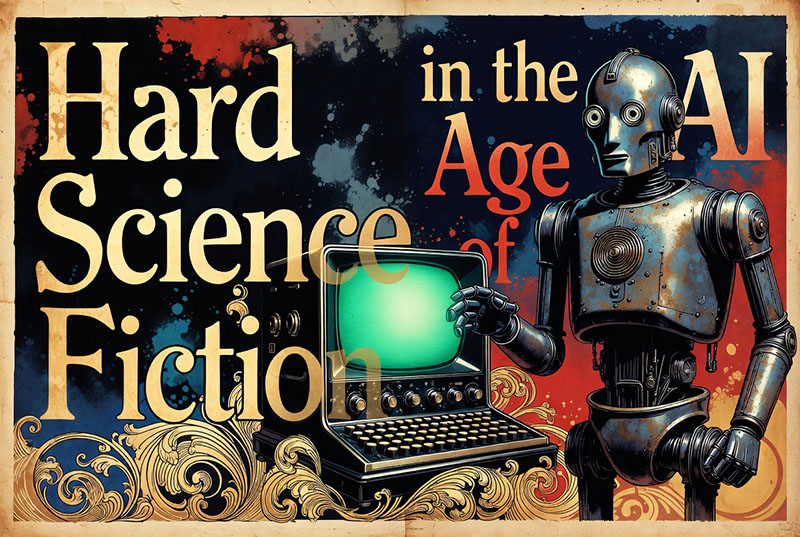
What Hard Science Fiction Can Do in the Age of AI
What Hard Science Fiction Can Do in the Age of AI
Hard science fiction has always promised something more than spectacle. At its best, it gives readers the thrill of ideas that feel as if they might actually happen. The ships may be strange, the intelligences post-human, the politics unfamiliar, but the logic holds. The future is built, not waved into existence.
That matters more now than it did a decade ago. We are living through an era in which artificial intelligence, automation, simulation and networked persuasion are no longer distant themes. They are part of everyday life. In that environment, hard science fiction does something uniquely useful: it lets us test moral, social and technological futures without pretending that human beings disappear from the equation.
Readers looking for hard science fiction are usually not hunting for gadget lists. They want rigour, yes, but they also want consequences. They want to feel that scientific and technological change has weight. They want stories that ask what new capabilities do to identity, power, loyalty, love and civilisation itself.
What competitors tend to emphasise
If you look at the wider field, many of the best-known writers in this space lean heavily into technical credibility and conceptual scale. Greg Egan foregrounds mathematical and physical speculation with extraordinary precision. Peter Watts often pushes biology, consciousness and survival into harsh territory. Charles Stross helped define singularity-era acceleration by showing how economics, computation and social systems can mutate faster than human intuition can comfortably follow.
All of that is valuable. It is part of why hard science fiction remains such a durable category. But there is still room within the genre for a slightly different emphasis: stories that take AI, post-human transition and civilisational change seriously without collapsing into nihilism.
Hard science fiction does not have to be emotionally cold
One of the lazier assumptions about hard science fiction is that it must sacrifice human depth in order to preserve intellectual seriousness. In practice, the opposite is true. Science matters more in fiction when it presses against recognisable human limits.
The interesting question is never just whether a machine can become conscious. It is what happens to family, culture, status, meaning and memory if it does. The interesting question is not only whether abundance becomes technically possible, but whether people can survive the transition from scarcity politics to post-scarcity possibility.
That is the territory I find most compelling as both a writer and a software engineer turned novelist. The future is not only a technical puzzle. It is also a psychological and moral one. That is why the strongest hard science fiction does more than explain a system. It dramatises what it feels like to live inside the system while it is changing.
AI fiction is strongest when it respects complexity
A lot of contemporary discussion about AI falls into two predictable modes: utopian hype or apocalyptic dread. Fiction can do better. Hard science fiction, in particular, is well placed to explore intelligence as a continuum rather than a switch. It can ask how machine agency emerges, how institutions respond, and how ordinary people adapt when the ground under their assumptions begins to move.
For readers interested in AI fiction books, that means the genre can offer something more durable than topical commentary. It can explore consciousness, alignment, persuasion, distributed systems and post-human identity at a scale that journalism rarely can. It can also remain entertaining while doing so.
That balance matters to me. On the main site, the aim is not to preach about the future but to tell stories set inside it. Across the books page, the Singularity's Children sequence follows a generation born into deep technological upheaval: not abstractly, but through conflict, humour, fracture and hope. These are novels about AI, power and transformation, but they are also adventure stories.
Why optimism is harder, and more interesting
There is a reason dark futures dominate science fiction marketing. Dystopia is easy to signal. It arrives with built-in drama. But genuinely thoughtful optimism is often harder to write because it cannot rely on collapse alone. It has to imagine systems that improve without becoming simplistic. It has to leave room for danger while preserving the possibility of meaning.
That is one reason I keep returning to positive futurist territory. As I explored in Why Optimistic Science Fiction Is Harder Than It Looks, hope is not the absence of conflict. It is conflict with a horizon beyond despair. For hard science fiction, that creates a productive tension: the more credible the science, the more earned the optimism has to feel.
For readers who want ideas and momentum
The best hard science fiction combines conceptual seriousness with narrative drive. It gives you enough intellectual structure to believe in the world, then sends characters crashing through the consequences. That is the kind of reading experience I value most, whether the subject is AI consciousness, post-human civilisation or the politics of technological transition.
If that sounds like your kind of science fiction, start with the books and audiobooks here. If you prefer to get a feel for the broader themes first, the blog explores writing, futurism, technology and the questions behind the fiction. You can also read more on why audio performance changes the experience in Why Science Fiction Audiobooks Hit Different.
Hard science fiction is sometimes treated as a narrow shelf label. I think it is better understood as a promise: that the future in the story has been thought through, and that the people inside it still matter. When that promise is kept, the genre can do something few others manage. It can make radical change feel intelligible, intimate and strangely possible.